

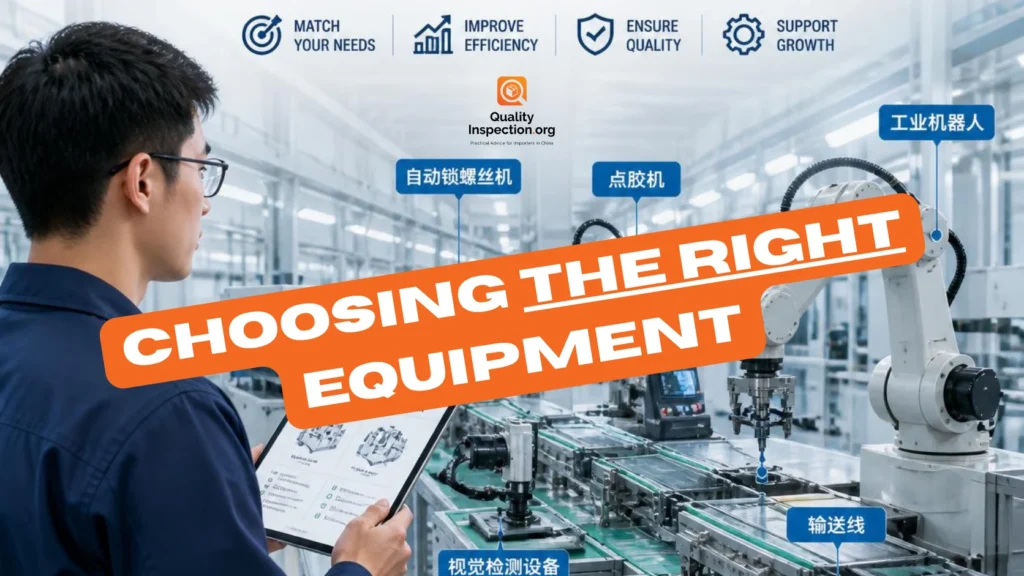
Many buyers focus heavily on product specifications, supplier selection, inspections, and incoming quality.
But there is another factor that can determine whether a factory can consistently make your product correctly: the equipment used on the production line.
A process may look simple on paper, but if the equipment is poorly selected, under-capacity, difficult to maintain, or incapable of holding the required tolerances, quality problems can quickly appear.
In this episode, we discuss how production equipment affects product quality, consistency, and scalability.
We also look at when manual processes stop being reliable enough, how flexible equipment differs from dedicated machinery, why machine capacity needs headroom, and how servicing and spare-parts availability can become serious production risks.
Finally, we share two real manufacturing examples where equipment choices directly affected product quality.
Listen to the audio here or on Apple Podcasts · Spotify · Amazon Podcasts · Deezer · iHeartRADIO · TuneIn.
What do we discuss?
- What drives the decision to invest in production equipment
Production volume is one of the first considerations. Expensive machinery may make little sense for a few hundred units, but once volumes reach thousands or tens of thousands per month, automation can become much easier to justify. Manufacturers also need to consider equipment cost, cycle time, labour requirements, and the break-even point. - Manual production versus machine process capability
A manual operator may be able to perform a task correctly, but repeating the same operation thousands of times can introduce variation. Where tight tolerances and consistent output are required, properly specified machinery can provide much better process capability over long production runs. - Flexible equipment versus dedicated machinery
Some machines can be programmed and shared across many different products, spreading their cost across multiple projects. Other processes require dedicated equipment designed specifically for one product, material, or operation. The right choice depends on production volume, required accuracy, flexibility, and cost. - Why production equipment is often under-specified
Manufacturers and product companies naturally want to control capital spending, especially at launch. But equipment chosen only for expected initial volumes can quickly become a bottleneck if sales grow faster than forecast. Building some capacity headroom into the production setup can therefore be very important. - The hidden impact of machine setup and changeover time
Programmable machinery does not necessarily switch instantly from one product to another. Calibration, alignment, setup checks, and trial runs may all be required. If this time is overlooked, the factory can significantly overestimate its true production capacity. - Why spare parts, servicing, and maintenance matter
Paul shares an example of a pick-and-place robot operating in China that needed a replacement component from Italy. The lead time was six weeks. A machine may perform perfectly when running, but poor local support or unavailable spare parts can create serious production downtime. Preventive maintenance and serviceability therefore need to be considered before equipment is selected. - When manual resin dispensing caused inconsistent quality
One product required a very precise amount of resin to be applied into a cavity. Doing the job manually with a syringe resulted in bubbles, poor curing, overflow, and inconsistent quality. A general-purpose automated dispenser also struggled because the resin was too viscous, so the team ultimately sourced dedicated equipment specifically suited to the application.
…and more! Please consider listening to the episode to hear the full story.
Further Reading
- 10 Key Factors That Affect Supplier Production Capacity
- How To Set Up A Process Control Plan [11 Steps]
- Chinese Manufacturer Selection: Beware of Excessive Automation
- How to Use Statistical Tools to Improve Production Processes
- Work Instructions 101 [FAQs]
- Mistake Proofing and Why It’s So Important for Manufacturers

