

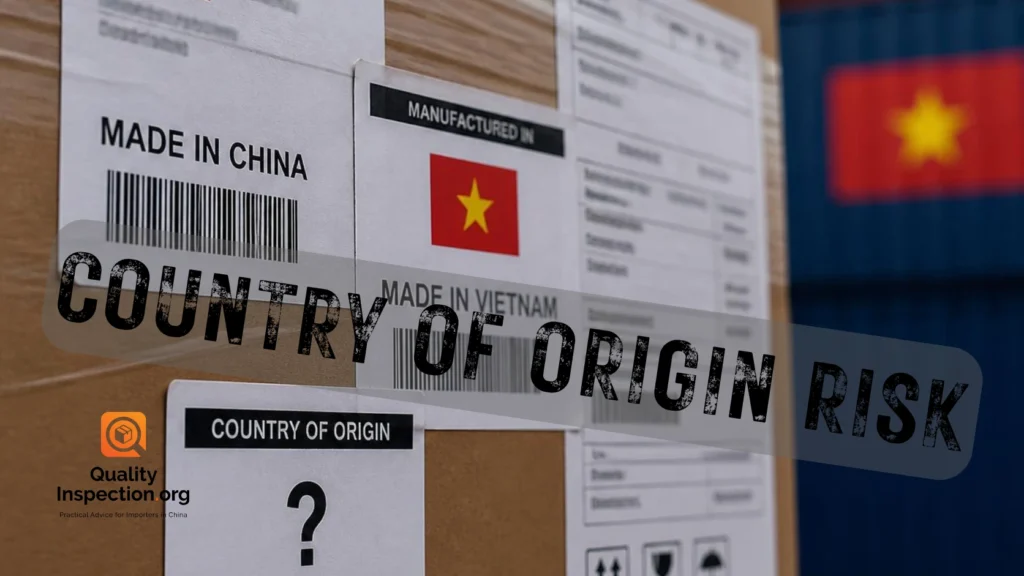
With U.S. tariffs continuing to affect many products imported from China, some buyers are looking again at China+1 manufacturing as a way to reduce their exposure.
A supplier may suggest carrying out part of the manufacturing in Vietnam, Cambodia, Malaysia, or another country. In some cases, this can be a perfectly legitimate supply-chain strategy. But simply shipping goods through another country, repackaging them there, or changing the country shown on the paperwork does not necessarily change the product’s actual country of origin.
For the importer, that creates two separate sets of risks.
- There is the question of whether the declared country of origin can genuinely be supported.
- Moving manufacturing activities into another country can introduce new suppliers, processes, logistics, quality problems, tooling requirements, IP exposure, and unclear responsibilities.
Read and listen as we discuss what importers should investigate before agreeing to a China+1 proposal and why tariff savings alone should not drive such an important supply-chain decision.
Listen to the audio here or on Apple Podcasts · Spotify · Amazon Podcasts · Deezer · iHeartRADIO · TuneIn.
What do we discuss?
- Why transshipment and country of origin matter to importers
When tariffs become significant, it can be tempting to accept a supplier’s proposal to route products through another country. However, importers should not assume that the supplier carries all of the responsibility if the declared origin is challenged. You need to understand what is genuinely happening in the supply chain. - Why shipping through another country isn’t enough
Moving finished goods from China to another country for repacking, relabelling, or minor work does not automatically make them products of that country. Importers should be able to explain what manufacturing actually took place and provide supporting evidence. - Understanding substantial transformation
The country in which the finished product is shipped from is not necessarily what determines its origin. The manufacturing processes involved matter, and the answer can vary according to the product. Renaud uses electronic products and PCBA manufacturing as an example of why buyers need to investigate the rules applying to their particular situation. - What to ask when a supplier proposes China+1
Which components will still come from China? Will any materials change? What manufacturing operations will move? Who will perform them? How will the new processes be validated? Will new testing, reliability, compliance, or quality checks be required? These questions should be answered before production is transferred. - Why the second factory needs to be verified
A supplier may say it has a factory or partner in another country, but buyers need to understand exactly what that relationship is. Is it genuinely their factory? A subcontractor? How much control do they have? Does the facility have the necessary equipment, quality system, people, and process capability? - Collect evidence of what really happens there
Factory visits, audits, photographs, production records, inspection reports, traceability information, and evidence of the manufacturing processes taking place can all be valuable. If the declared country of origin is later questioned, simply showing a commercial invoice may not be enough. - China+1 creates new quality risks
Adding another factory means adding another point at which things can go wrong. Assembly, final testing, inspection, packaging, operator training, and process control may all need to be established again. A mature process in China does not automatically become a mature process when moved elsewhere.
…and more! Please consider listening to the episode to hear the full story.
The key takeaway for importers
There is nothing inherently wrong with adopting a China+1 strategy.
The mistake is treating it as a shortcut where products can simply be routed through another country and given a different country-of-origin label.
If manufacturing really is going to move, buyers should approach the project with the same diligence they would use when introducing any new factory or production process: understand exactly what is changing, verify the facility, validate the processes, document what happens, and make sure responsibilities are clear.
And because country-of-origin requirements can depend on the specific product and manufacturing process, importers should obtain appropriate customs or legal advice rather than relying solely on what their supplier tells them.
Further Reading
- Why “China Plus One” Isn’t What You Think For Electronics
- Pulling Your Tooling from Chinese Manufacturers: Key Risks and Best Practices
- Manufacturing in China for the U.S. in 2026: Tariffs, China+1, and the Real Cost of Moving Production [Podcast]
- How To Choose Which Factory Audit You Need?
- Vietnam-US Trade Deal: Trump’s Tariff Tactics & Transshipment Troubles [Podcast]
- Setting up Manufacturing in Vietnam vs China: Focus on Vietnam
- U.S. Customs and Border Protection — CROSS (Customs Rulings Online Search System)

