

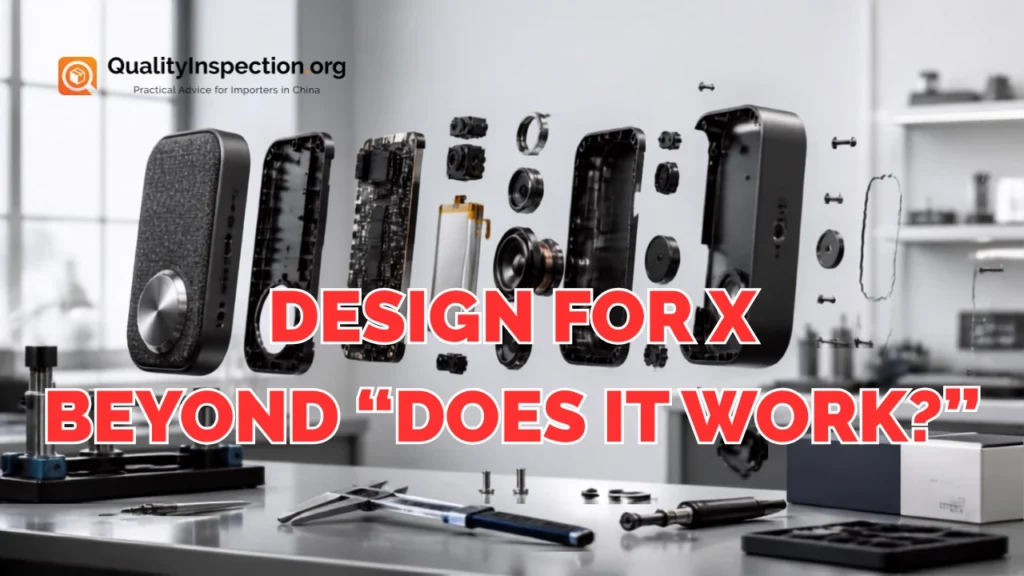
Let’s revisit a discussion with reliability expert Andrew Amirnovin about Design for X (DfX) and 12 different objectives product developers can optimize for.
A product that works is only the starting point. To succeed in production and in customers’ hands, it also needs to be designed with manufacturing, assembly, quality, reliability, testing, packaging, maintainability, usability, and other practical requirements in mind.
They explain why DfX decisions need to be made early in product development, how simplifying a product can reduce manufacturing and quality risks, and why different products require different priorities rather than trying to optimize everything equally.
Listen to the audio here or on Apple Podcasts · Spotify · Amazon Podcasts · Deezer · iHeartRADIO · TuneIn.
What do we discuss?
- 01:46 – Designing for shorter development and time to market
Why simplifying a product and reducing unnecessary technical complexity can shorten development without taking dangerous shortcuts. - 04:26 – Designing for crowdfunding
How crowdfunding can influence product development priorities, including getting to an attractive prototype early enough to demonstrate the product and test demand. - 07:12 – Design for Manufacturing and Design for Assembly
DFM and DFA are two of the most important DfX disciplines. We discuss manufacturing processes, assembly-line design, supplier and component selection, mistake-proofing, jigs and fixtures, and reducing operator variability. - 15:57 – Fewer parts, standard components, and easier assembly
Why reducing part counts, using common or proven off-the-shelf components, and making assembly difficult to get wrong can lower cost and reduce quality and reliability risks. - 19:23 – Using modularization to simplify products
How tested modules can reduce assembly complexity, support standardization, make repairs easier, and reduce the number of opportunities for something to go wrong. - 23:35 – Design for quality
Quality problems can originate in the design itself. The discussion covers whether parts can actually be manufactured consistently at the required quality level, supplier qualification, testing, process controls, and why quality expertise should be involved early.
…and more! Please listen to the episode to hear the full story.
The key DfX takeaways for importers
Here are a few key DfX takeaways from this discussion:
- A working prototype is not the same as a production-ready product. DfX helps teams consider manufacturing, assembly, quality, reliability, testing, packaging, maintainability, usability, and other real-world requirements before they become expensive problems.
- Simpler products are usually easier to develop and manufacture. Fewer parts, more standard components, modularization, and mistake-proofed assembly can reduce cost, variability, and quality risks.
- Quality and reliability should be designed in early. Supplier selection, component choices, manufacturing processes, testing, and the expected use environment all need to be considered before the design is frozen.
- You do not need to optimize every DfX objective equally. The right priorities depend on the product, customers, use case, production volumes, and business model.
- DfX works best as a cross-functional process. Engineering, quality, reliability, manufacturing, and project management should review the design together and challenge assumptions while changes are still relatively easy to make.
Further Reading
- Agilian – DfX, Industrialization & NPI Support
- Sofeast – The New Product Introduction Process Guide
- QualityInspection.org – How Good DFM and DFA Help with Production Cost & Quality
- QualityInspection.org – The Design for Reliability Process for Launching Reliable Products
- QualityInspection.org – Don’t Leave Packaging Until the End
- Agilian – Why Test Components and New Products to Failure During NPI?

