

Getting a new product into mass production quickly sounds like an obvious goal.
You want to launch your new product, start generating revenue, and meet commitments to customers, retailers, or investors.
Your manufacturer also wants to move ahead because mass production is typically where the factory starts making meaningful money.
So both sides can push in the same direction: start mass production as soon as possible.
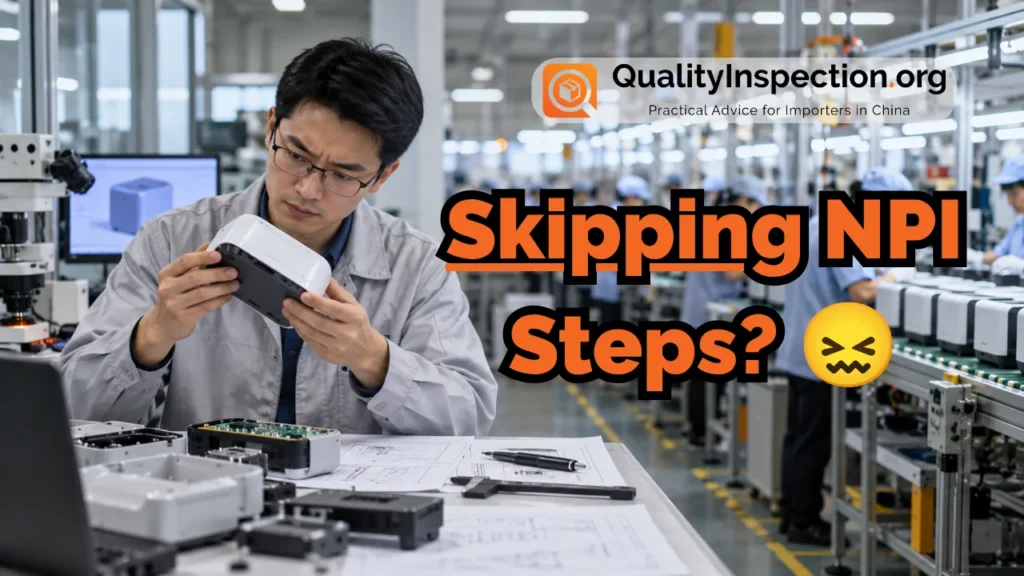
The problem is that this pressure can lead to important New Product Introduction (NPI) steps being shortened or skipped.
Engineering reviews, manufacturing-process development, testing, pilot runs, fixtures, tooling adjustments, and other validation activities all take time and resources before large production orders begin.
For a familiar product that a factory already produces every day, moving quickly may carry relatively little risk.
But for a new or highly customized product, the manufacturing and testing processes often need to be developed and proven too.
And buyers are not innocent here, either.
Launch deadlines, cash-flow pressure, retailer commitments, crowdfunding promises, and limited funding can all encourage a company to accept more production risk than it normally would.
The danger is that a problem that might have been relatively easy to correct during a pilot run may only become obvious after components have been purchased — or thousands of finished units are already sitting in a warehouse.
In this episode, we discuss why both suppliers and buyers are tempted to skip NPI steps, what happens when production is scaled too early, and why reaching predictable and consistent mass production is a better objective than simply reaching mass production as fast as possible.
Listen to the audio here or on Apple Podcasts · Spotify · Amazon Podcasts · Deezer · iHeartRADIO · TuneIn.
What do we discuss?
- 01:05 – Why buyers and suppliers are tempted to skip NPI steps
Why both sides often have commercial reasons to move quickly, even when more engineering, testing, or validation work would reduce risk. - 02:33 – Why manufacturers want to reach mass production quickly
Factories generally make their money when products are being manufactured and shipped at volume. Smaller pilot runs, engineering work, and repeated process development consume resources before those larger orders begin. - 05:35 – When moving quickly is relatively safe, and when it isn’t
A factory may be able to move fast when it is producing something very similar to an established product using proven processes. A genuinely new or highly customized product is different because its manufacturing and testing processes may also need to be developed. - 09:57 – Does your supplier really know how to manage NPI?
Why manufacturing experience alone doesn’t necessarily mean a supplier can industrialize a new product, and why buyers should establish who will actually drive process development, validation, testing, and production readiness. - 13:58 – Why buyers knowingly accept NPI risks
Launch dates, funding constraints, customer commitments, and the need to generate revenue can all push companies toward production before the product and process are fully mature. - 23:06 – What happens when the problem appears after 10,000 units have been made?
Large batches magnify risk. Custom components, incomplete specifications, untested suppliers, or immature processes can become extremely expensive problems once substantial inventory has already been produced. - …and more! Please listen to the episode to hear the full story.
The key Takeaway
Skipping an NPI step does not necessarily eliminate a problem. Very often, it simply means the problem is discovered later.
And the later a manufacturing problem is discovered, the more expensive it is likely to be.
Before mass production, a team still has opportunities to change a drawing, improve a fixture, adjust tooling, qualify a component, modify a test process, or run another pilot batch.
Further Reading
- QualityInspection.org – Pilot Run Best Practices
- QualityInspection.org -Why YOUR Manufacturing Project Needs Phase Gate Reviews
- QualityInspection.org -What QC Processes Should Be Set Up Before Mass Production?
- QualityInspection.org -7 Must Do New Product Introduction Tasks For Successful Product Launches
- QualityInspection.org -Don’t Skip the Pilot Run for Your New Product Made in China!
- Sofeast – Transitioning to Manufacturing from Product Development | 2 Options
- Agilian Technology – How Multiple Pilot Runs Can Reduce Risks You Never Saw Coming

