

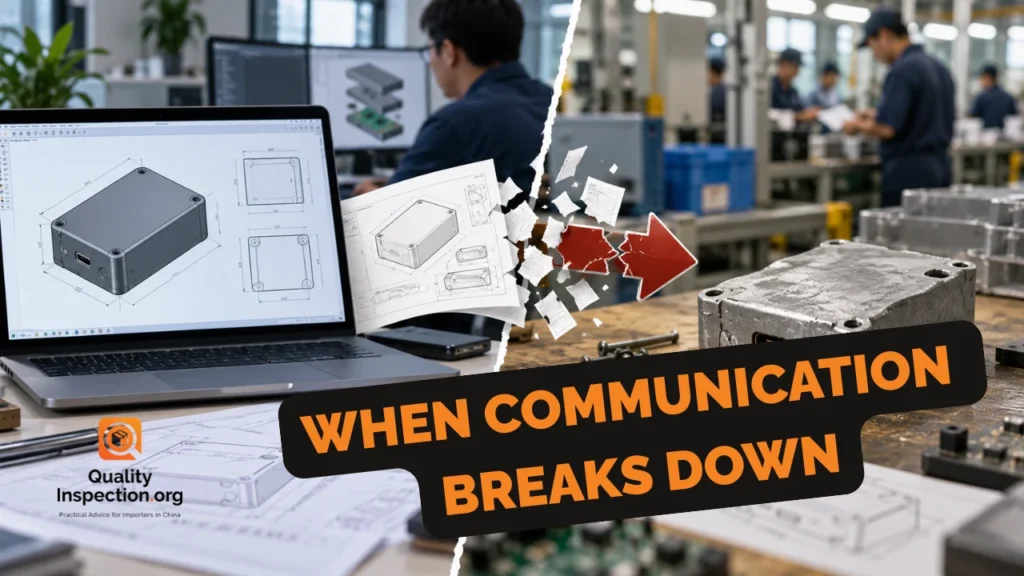
A hardware project can appear to be progressing perfectly well until the first prototype, tooling sample, or production unit arrives and something is wrong.
Frustratingly, it’s neither broken, nor badly made. It’s just not what you expected.
This is one of the most frustrating situations in product development because everyone involved may genuinely believe they did their job correctly.
- You gave instructions.
- The engineers created the design.
- The supplier followed the drawing.
- Purchasing placed the order.
- Production built the parts.
So where did the project go wrong?
Very often, the answer is communication.
We’ll discuss how communication gaps quietly create delays, rework, additional cost, and confusion throughout hardware product development.
The problem is not usually that nobody communicated.
It is that information was passed along without making sure everybody understood it in the same way.
Listen to the audio here or on Apple Podcasts · Spotify · Amazon Podcasts · Deezer · iHeartRADIO · TuneIn.
What do we discuss?
- 01:31 – How miscommunication creates hardware project delays
Why hardware issues can remain hidden until a prototype or physical part is produced, and how assumptions made early in the project can turn into costly delays later. - 08:01 – Where communication breaks down in hardware development
How information passes between customers, designers, engineers, purchasing teams, suppliers, quality teams, and production — and why every handoff creates an opportunity for misunderstanding. - 10:52 – Language, terminology, and supplier misunderstandings
Why unclear specifications, technical terminology, translation issues, and even mixed measurement units can cause problems if suppliers and engineering teams do not question what they receive. - 18:31 – Engineering, supplier, and design handoffs
How drawings, CAD files, tolerances, materials, surface finishes, tooling requirements, and supplier capabilities should be reviewed and confirmed before manufacturing starts. - 21:49 – Keeping cross-functional teams aligned
The role of project managers, R&D, purchasing, production planning, quality teams, and suppliers, and why regular customer communication keeps everyone working from the same expectations. - 30:29 – Five practical ways to improve hardware project communication
Paul shares five key habits: audit every handoff, make assumptions visible, confirm understanding rather than receipt, maintain one source of truth, and formally document changes. - 39:14 – A real-world communication problem caught early
An example of how an English-language requirement was misinterpreted by a China-based team, and how going back to the customer quickly prevented the misunderstanding from becoming a much larger problem. - …and more! Please listen to the episode to hear the full story.
The key Takeaway
Good hardware project communication is not about sending more emails or holding more meetings.
It is about making sure everybody shares the same understanding.
The safest approach is to:
- Question unclear requirements
- Challenge assumptions
- Confirm understanding
- Maintain controlled documentation
- Keep communication flowing in both directions
- Formalize changes once the project reaches later stages
Every time information moves from one team to another, ask yourself:
Was the information merely sent, or was it actually understood?
That simple distinction can prevent a surprising number of costly hardware development problems.
Further Reading
- Sofeast – Importing from China? Use this product specifications template.
- Sofeast – Good and Bad Methods of Communication with your Chinese Supplier [Podcast]
- Sofeast – Why Hardware Projects Stall: Avoiding ‘Failure to Launch’ [Podcast]
- QualityInspection.org – Product Requirements Document: Underpinning Hardware Product Development

