

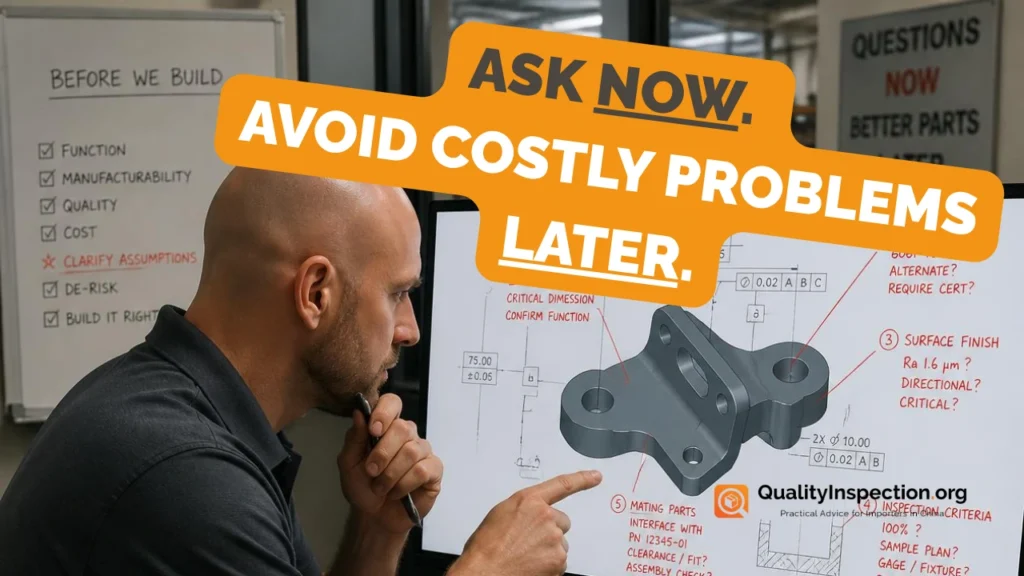
You send a manufacturer your CAD files, drawings, specifications, and requirements and expect the next step to be fairly simple: they review everything, tell you what it will cost, and provide a lead time.
Instead, they come back with a long list of questions.
For buyers eager to get a project moving, that can feel like the manufacturer is slowing things down. In reality, the opposite may be true.
An experienced manufacturer asks questions because drawings and specifications do not always explain everything they need to know about how a product should function, where it will be used, how components interact, what quality level is acceptable, or which requirements are genuinely critical.
In this episode of the China Manufacturing Decoded podcast, Adrian is joined by Agilian Technology’s Paul Adams to explain why those questions matter and what manufacturers are actually trying to uncover before giving firm answers or moving into production.
They discuss how assumptions become embedded in product specifications, why unnecessarily tight tolerances increase cost and rejection rates, what manufacturers need to know about materials and operating environments, why inspection criteria need to be clearly defined, what information buyers should provide when requesting a quotation, and how the quality of a manufacturer’s questions can reveal a great deal about their technical capability.
Listen to the audio here or on Apple Podcasts · Spotify · Amazon Podcasts · Deezer · iHeartRADIO · TuneIn.
What do we discuss?
- Why a good manufacturer should ask questions before quoting
CAD files, drawings, and specifications provide important information, but they may not provide all of the context required to manufacture a product successfully. A manufacturer should try to understand what the product and its individual parts actually need to do rather than simply accept everything they receive without question. - Why assumptions can become expensive manufacturing problems
If something is not discussed, it can easily become accepted as a requirement by default. Those assumptions can then influence tooling, materials, tolerances, inspection, and production. Discovering that an assumption was wrong after parts have already been produced may mean rework, tooling modifications, delays, and additional cost. - Why tighter tolerances are not automatically better
Paul uses the example of a very tight tolerance that may not actually be necessary for the function of the component. Manufacturing to tighter tolerances generally requires greater process control and can result in higher rejection rates. A good manufacturer should therefore ask whether the requirement is really necessary rather than simply manufacturing exactly what is written. - Understanding how and where the product will be used
Manufacturers need to understand the product’s function and operating environment. Temperature, humidity, UV exposure, chemical contact, repeated loads, and whether the product will be used indoors or outdoors can all affect material and surface-finish decisions. - Mating parts and tolerance stack-ups need particular attention
Components need to work together correctly. A sliding fit, snap fit, friction fit, or required clearance may depend on several dimensions across several different components. Looking only at individual part tolerances without considering how they accumulate can result in an assembly that does not fit or function as expected.
…and more! Please listen to the episode to hear the full story.
The key takeaway for importers
Receiving a long list of questions from a manufacturer should not automatically be viewed as a delay.
Good manufacturing depends on replacing assumptions with clearly defined requirements before expensive decisions are made.
The manufacturer should understand how the product functions, where it will be used, how its components interact, what really needs tight control, and how the finished product will be judged. At the same time, the buyer should provide detailed information and be prepared to answer and ask technical questions.
The quality of those conversations also gives you useful information about the manufacturer itself. A supplier that simply says “yes, no problem” to every drawing and requirement may not be examining the project deeply enough. A more experienced team is likely to question requirements that appear inappropriate, incomplete, contradictory, or unnecessarily difficult to manufacture.
The practical principle running throughout the episode is simple: Smart questions at the start are cheaper than solving problems at the end.

