

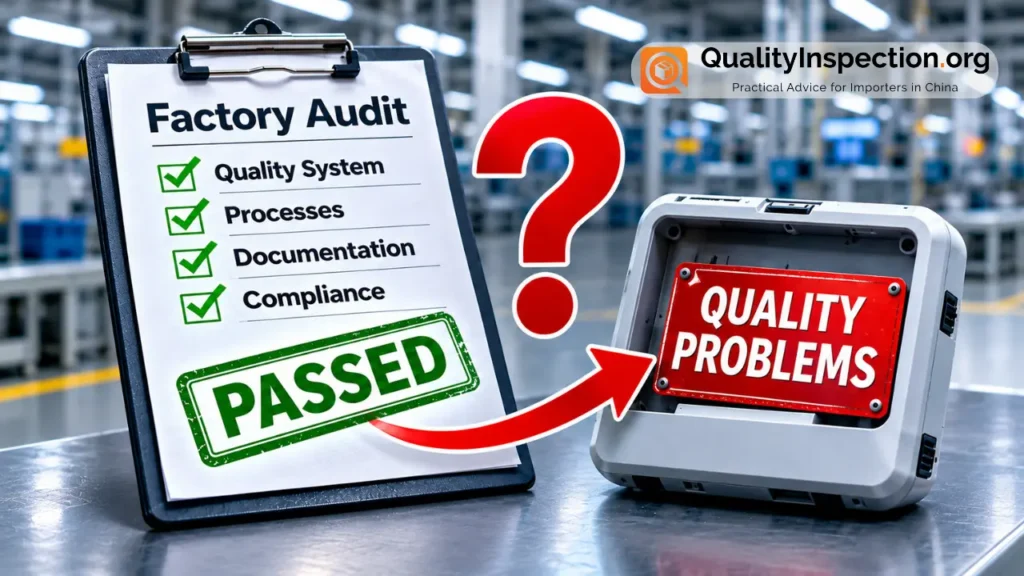
You arranged a factory audit before placing your order with a Chinese manufacturer. The results were satisfactory; the quality management system appeared to be in place, and you felt confident enough to approve the supplier.
But several months later, you’re dealing with defective products, inconsistent manufacturing quality, or repeated production problems. How could this happen if the factory passed its audit?
In episode 353 of China Manufacturing Decoded, Adrian from Sofeast discusses this question with Renaud Anjoran. They explore what factory audits actually tell buyers, why a positive audit result doesn’t guarantee consistent manufacturing quality, and what can cause a supplier’s performance to deteriorate.
An important distinction emerges from their discussion: a factory may have a reasonably well-organized quality management system without having the technical capabilities, process controls, or operational discipline needed to manufacture a particular product consistently.
Listen to the audio here or on Apple Podcasts, Spotify, Amazon Music, and other podcast platforms.
Episode Sections
Here’s a summary of the main topics discussed, but listen to the episode for the complete explanations and examples.
What does passing a factory audit actually tell you?
First, we need to define what it means for a factory to pass its audit.
In this discussion, Renaud focuses mainly on quality management system audits, similar in scope to assessments based on ISO 9001 requirements.
These audits examine whether the manufacturer has appropriate systems and procedures in place. For example, does it check incoming materials, establish responsibilities, provide work instructions, inspect products during manufacturing, and maintain quality records?
An acceptable audit result suggests that the manufacturer has established systems for managing quality, at least within the scope of the assessment.
However, that is not the same as proving that the factory can consistently manufacture your particular product.
Renaud also warns against relying too heavily on simple checklist audits.
An auditor who merely confirms that procedures and records exist may give a factory a high score without identifying important weaknesses in its operations.
For example, a factory could receive a score of 90% on a superficial assessment while still having serious manufacturing deficiencies.
The quality of the audit matters, not just its numerical result. Renaud recommends audits that require the auditor to observe, investigate, and describe what is happening rather than simply ticking boxes.
He also makes an important point about how buyers should interpret the findings.
An audit is a tool for gathering information and comparing risks between potential suppliers. The auditor provides the evidence, but the buyer remains responsible for deciding whether the supplier is suitable.
A positive report should not be interpreted as a guarantee that future production will be trouble-free.
Why manufacturing quality can deteriorate after a successful audit
Even when the correct factory has been audited and initially performs well, conditions can change considerably over time.
Renaud emphasizes that an audit is a snapshot of the factory at a particular moment.
Consider a toy manufacturer.
During the quieter months, production volumes may be relatively low. Experienced workers have sufficient time to follow procedures, equipment is available, and inspections can be carried out as planned.
Now imagine visiting the same factory during its busiest production season.
The workforce may have expanded rapidly, employees could be working long hours, and managers may be under pressure to ship several containers before strict deadlines.
The factory still has its documented procedures, but people might start taking shortcuts.
Renaud gives the example of a manufacturer producing plush toys that normally pass through metal detectors to identify potentially dangerous fragments, such as broken sewing needles.
During peak production, there may be pressure to skip or postpone these checks to keep shipments moving.
This illustrates how a factory can have appropriate quality controls on paper but fail to apply them consistently when production pressures increase.
When poor product design is mistaken for a manufacturing problem
Another important part of the discussion concerns responsibility for manufacturing defects.
When a product develops recurring quality problems, buyers often assume that the factory is to blame.
However, Renaud explains that the original product design can sometimes make consistent manufacturing extremely difficult.
Imagine a molded component that requires very precise processing conditions.
The manufacturer might need to control pressure, speed, temperature, and cycle time within a very narrow range to produce acceptable parts.
The factory manages to get the process working during initial trials, but small variations during mass production cause defects.
Is this necessarily a manufacturing failure?
… and more, please listen to the episode in full.
The Last Word…
Factory audits remain a valuable part of qualifying Chinese suppliers. They can help buyers compare manufacturing facilities, identify weaknesses, and make more informed sourcing decisions.
However, an acceptable audit result is not a promise that the manufacturer will produce defect-free goods indefinitely.
The effectiveness of an audit depends on its scope, the auditor’s competence, and whether the assessment examines actual working practices rather than simply checking documentation.
Buyers also need to recognize that manufacturing conditions change.
Production pressures, staff turnover, subcontracting arrangements, material variations, and poorly controlled processes can undermine quality long after the original supplier assessment.
And when problems emerge, the manufacturer is not necessarily the only party responsible. Product design and insufficient manufacturing validation can be equally important.
The practical lesson is to treat supplier qualification as the beginning of a longer process.
Use the initial audit to understand the risks, establish suitable product and process controls, and continue monitoring the areas that matter most.
For important suppliers, targeted follow-up audits can help verify improvements and identify developing problems before they become serious.
A factory may have passed its audit, but the real test is whether it can consistently manufacture your product to the required standard.
Further Reading
- Using Factory Audits to Qualify Your Chinese Suppliers — How to choose the right audit and why supplier assessments should reflect the buyer’s actual risks.
- China Supplier Vetting Part 7: Factory Process & System Audit — Why evaluating manufacturing processes requires going deeper than a general quality system audit.
- The Real Purpose of Factory Audits? Evaluate and Prevent Risks — How factory audits support supplier selection and ongoing improvement.
- Conducting Factory Audits for Continuous Improvement — Examples of focused, recurring audits designed to improve factory systems and processes.
- When Your Chinese Factory Changes Components Without Approval: Risks and Remedies — Our previous episode exploring unapproved material changes and quality fade.

