

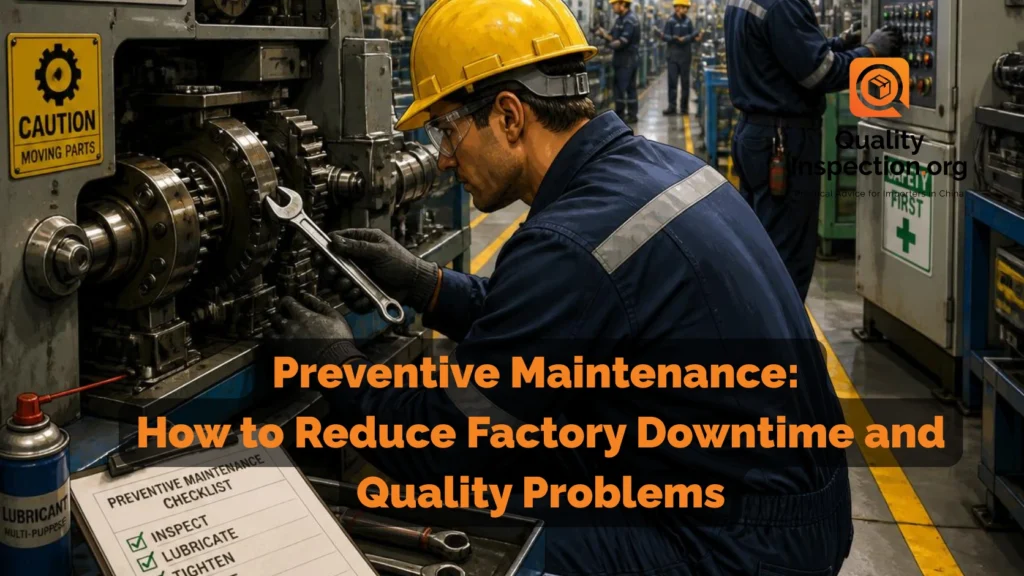
A machine in the factory doesn’t need to stop working completely before it starts causing problems.
Worn tooling, loose components, blocked filters, inadequate lubrication, and other forms of equipment deterioration can gradually affect process stability and product quality. By the time the machine finally breaks down, the factory may already have produced hours, or even days, of defective products.
Preventive maintenance helps factories identify and address these risks before they turn into costly production emergencies. It replaces unpredictable breakdowns with planned inspections, cleaning, servicing, and component replacement.
Join us as we explain how preventive maintenance can reduce defects, unplanned downtime, excess inventory, delayed shipments, and emergency repair costs. We also discuss how it works alongside 5S, process control, and factory automation to support more consistent manufacturing performance.
Listen to the audio here or on Apple Podcasts · Spotify · Amazon Podcasts · Deezer · iHeartRADIO · TuneIn.
Table of Contents
Episode Summary
- 00:00 – Why preventive maintenance matters
Adrian introduces this CMD Gold episode and explains why factories with experienced employees and expensive machinery can still suffer from defects, delays, and lost production capacity. - 01:10 – What happens when factories rely on reactive maintenance
Renaud describes the typical cycle in a poorly managed factory: machinery is installed, operated until it fails, and then repaired under intense production pressure without the necessary spare parts or preparation. - 03:06 – What preventive maintenance means
Preventive maintenance replaces unexpected breakdowns with planned inspections, cleaning, servicing, and component replacement. Some downtime remains, but it occurs at a controlled and convenient time. - 04:29 – Is preventive maintenance more expensive?
An unexpected equipment failure can produce defective parts, disrupt production planning, create material shortages, leave workers idle, and shorten the useful life of the machinery. These costs are often far greater than the cost of planned maintenance. - 07:42 – Daily, weekly, and usage-based maintenance
Operators can perform simple daily checks such as cleaning filters and looking for oil leaks. Technicians can conduct more detailed weekly inspections, while other components should be serviced or replaced according to operating hours or production cycles. - 11:52 – Why factories resist planned maintenance
Production managers may be reluctant to stop machinery while orders are waiting. This can create conflict between production and maintenance teams and encourage factories to operate equipment until it fails. - 13:05 – Maintenance skills and automation
More advanced automation creates more potential points of failure and requires better-trained technicians. Factories should automate progressively and make sure each new system is reliable before adding further complexity. - 15:32 – Capacity, inventory, and customer benefits
Reducing unexpected downtime increases usable factory capacity. It can also allow the manufacturer to hold less protective inventory, offer shorter lead times, improve labor productivity, and deliver more reliably. - 18:17 – Preventing defects and supporting process control
Worn or damaged machinery may continue producing bad parts before anyone realizes something is wrong. Preventive maintenance, 5S, and process monitoring reinforce one another by revealing deterioration before it causes a major failure. - 20:12 – Planned maintenance or emergency repairs
Maintenance is unavoidable. A factory can either perform it according to a documented plan or wait until equipment breaks and employees, production schedules, and customers are already affected.
Takeaways
- Every factory pays for maintenance. Preventive maintenance determines when that cost is incurred and limits the disruption it causes.
- Machines can produce defects before failing. Equipment deterioration is therefore a quality risk as well as a downtime risk.
- Operators and technicians have different responsibilities. Operators can complete basic daily checks, while trained personnel handle more detailed servicing.
- Maintenance can be time- or usage-based. Replacement intervals may depend on days, operating hours, production cycles, or measured deterioration.
- Production pressure is a major obstacle. Factories frequently postpone maintenance because they do not want to stop a busy machine.
- Automation increases maintenance requirements. More advanced equipment introduces additional failure points and demands stronger technical capabilities.
- Good maintenance increases effective capacity. More reliable equipment improves output without necessarily requiring additional machinery.
- 5S, process control, and maintenance work together. Clean, controlled processes make developing problems easier to identify.
Further Reading
- Preventive Maintenance Plan Template
- Is Investing In Process Automation In The Factory Worth It? + Implementation Best Practices [Podcast]
- Two Preventive Maintenance Examples: Go for More Structure
- Are Preventive Maintenance and Process Control the Same Thing?
- Manufacturing Cycle Time (Part 1): Machining Optimization
- Why Inconsistent Component Variation Is Bad for Assembly & Product Quality
- 10 Key Factors That Affect Supplier Production Capacity
- 3 Key Process Improvement Tools You Need To Start Using: Flow Chart, FMEA, Control Plan

