

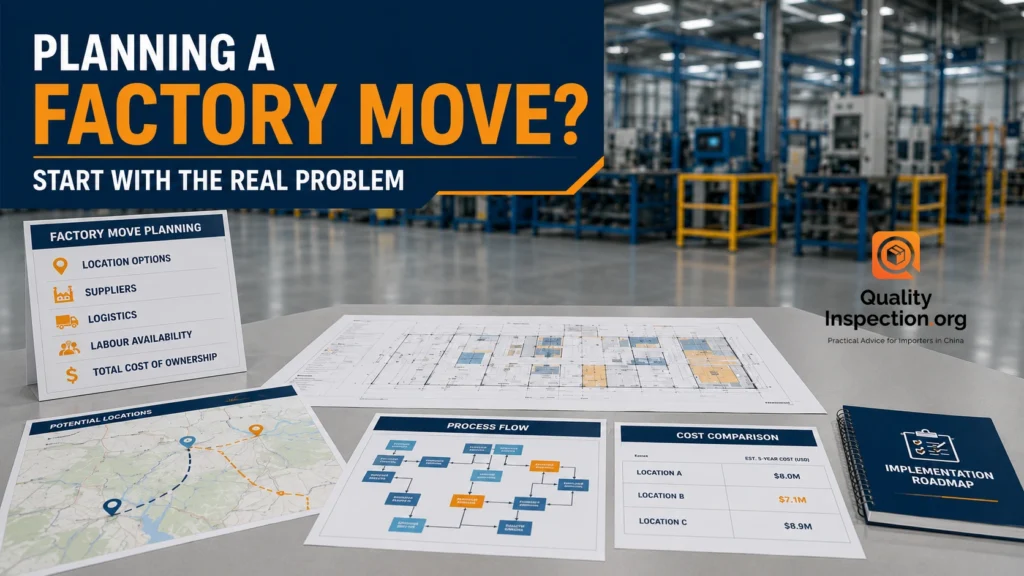
Some importers we meet are rethinking where their products are made.
Some are worried about tariffs. Others want to reduce China-related risks, move closer to their customers, protect their IP, or stop relying on a single supplier that has too much control over their production.
So the idea comes up: should we move production to a new factory?
Maybe Vietnam looks attractive. Maybe Mexico seems closer to the US market. Maybe another supplier in China can do the job. Or maybe the company decides it should own the manufacturing process itself.
But a factory move is not automatically an improvement.
If the current production setup has a poor layout, weak process controls, too much inventory, unreliable equipment, or a poorly understood supply chain, moving to a new building may simply copy those same problems into a different location.
That was one of the main points made by David Collins, CEO of Manufacturing Transformation Group, in a recent discussion with Renaud Anjoran on the China Manufacturing Decoded podcast.
Before choosing a country, a supplier, or a building, companies need to ask a more basic question:
What problem are we really trying to solve?
Listen to the audio here or on Apple Podcasts · Spotify · Amazon Podcasts · Deezer · iHeartRADIO · TuneIn.
Table of Contents
Episode Sections:
- 00:00 – Introduction: setting up a new factory
- 01:43 – Who David Collins and Manufacturing Transformation Group are
- 05:04 – Why more companies are considering factory relocation
- 05:50 – China, Vietnam, Mexico, and the real trade-offs between locations
- 08:10 – Why some companies want to own manufacturing again
- 09:32 – Don’t just move the mess to a new factory
- 11:45 – The first question: what are you trying to accomplish?
- 12:02 – Supplier location, workforce skills, logistics, and infrastructure
- 14:18 – Why a real BOM and cost model are essential
- 15:27 – Feasibility studies and idealised factory planning
- 16:07 – Why automation is not always the right answer
- 17:34 – Comparing factory setup scenarios and locations
- 18:16 – Why labour cost should not be the only driver
- 20:48 – IP risks and supplier dependency
- 22:15 – Learning from the problems in your current factory
- 23:46 – Project management during a factory move
- 24:03 – Greenfield vs brownfield factory projects
- 26:09 – Layout planning, implementation, and local specialists
- 27:13 – On-the-ground project management and construction risks
- 28:33 – Equipment commissioning and factory acceptance testing
- 29:50 – Choosing equipment that fits your real needs
- 31:41 – Equipment maintenance, spare parts, and supplier risks
- 32:40 – Why factory setup is a once-in-a-decade decision
- 34:12 – Disciplined planning and avoiding old mistakes
- 36:45 – Closing thoughts
Further Reading
- How To Plan for Transferring Production To a New Factory: 45 Point Checklist
- Transfer Manufacturing From One Chinese Factory To Another With Fewer Risks
- How To Diversify Manufacturing Sources Out of China and Cut Risk
- Sofeast can help you > Electronic Production Transfer from China to India OR Malaysia
- Supply Chain Risk Management, Part 5: Moving Manufacturing to Vietnam, Thailand, Malaysia, or India (Pros & Cons)
- Production Transfer: A Roadmap (Assembly Operations Only)

