

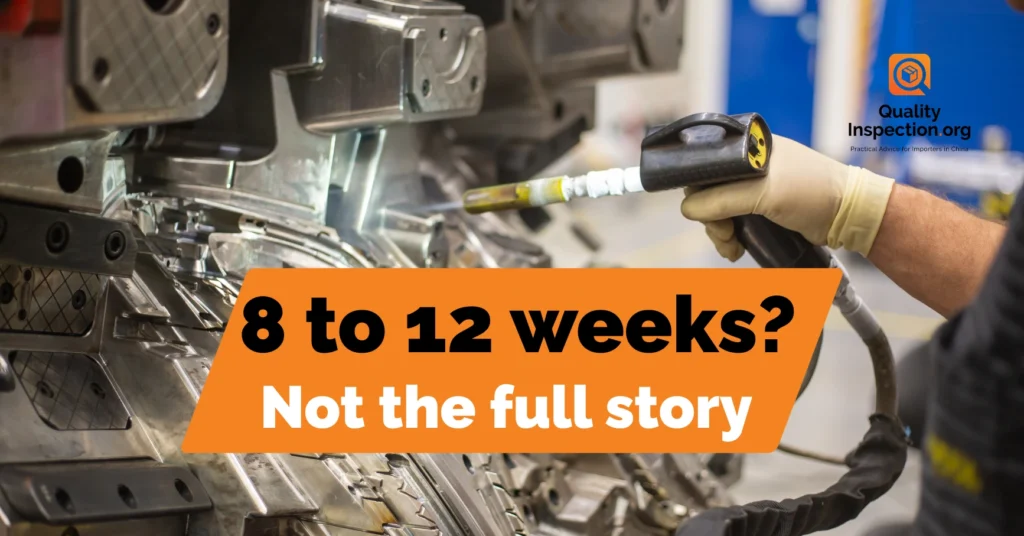
Many buyers hear the same thing when they ask about injection mold tooling: “About 8 to 12 weeks.”
That sounds like a plan. It is not. Here’s why…
It may be a reasonable estimate for a simple mold: one straightforward plastic part, one cavity, no sliders, no undercuts, no difficult surface finish, and standard pre-hardened steel. But most real products are not that simple.
A consumer electronics or IoT product might include several molded parts, each with its own tool, complexity, steel requirements, tolerances, surface finish, and review process. One difficult housing, cover, bracket, or internal frame can become the critical path for the whole project.
The bigger issue is that many buyers misunderstand when the tooling clock starts. It usually does not start when the purchase order is placed or the deposit is paid. Before the toolmaker can start machining, the design often needs to go through a DFM review, questions need to be answered, changes may need to be approved, and the final tool design must be confirmed.
In episode 331 of China Manufacturing Decoded, Adrian spoke with Paul Adams, Head of New Product Development at Agilian Technology, about why the common 8–12 week tooling estimate often creates false expectations. They discussed what really affects tooling lead times, including DFM readiness, part complexity, steel selection, toolmaker capacity, T0/T1/T2 trials, customer response speed, and China’s holiday calendar.
Before you approve tooling, you need to understand which parts are complex, whether the design is really ready, what steel is being used, when machining actually starts, how trial parts will be reviewed, and what buffer is needed if changes are required.
Otherwise, the “8 to 12 weeks” you remember may quietly become 14 to 16 weeks, or longer.
The takeaway is simple: do not treat a tooling quote as a project plan.
Listen to the audio here or on Apple Podcasts · Spotify · Amazon Podcasts · Deezer · iHeartRADIO · TuneIn.
Table of Contents
Episode Sections:
- 00:00:31 – The “8 to 12 week tooling timeline”
- 00:02:28 – What tooling includes and why it matters
- 00:04:21 – Tooling cost and why first-time founders get caught out
- 00:06:08 – Where the 8 to 12 week figure comes from
- 00:07:23 – Why real consumer electronics products are more complex
- 00:08:35 – When the tooling timer really starts
- 00:11:10 – Why design readiness and DFM review are critical
- 00:13:26 – How part complexity affects tooling lead time
- 00:13:50 – Steel selection: P20, H13, and tool life
- 00:15:40 – Responsiveness during T0, T1, and T2 trials
- 00:16:26 – Why being in China can speed up tooling decisions
- 00:19:03 – Planning around Chinese New Year, Golden Week, and May Day
- 00:21:47 – How to create a tooling schedule that works
- 00:22:05 – Reviewing the DFM report properly before cutting steel
- 00:24:00 – Building a tooling specification and critical path plan
- 00:25:34 – Understanding T0, T1, T2, and rework cycles
- 00:27:45 – Why you should always build in a schedule buffer
- 00:28:56 – Why many tooling delays come from the customer side
- 00:30:15 – Final advice: understand the full tooling process
Further Reading
- Tooling Management for Plastic Injection Molds in China
- Plastic Injection Mold Tooling Management & Risk Reduction [Podcast]
- Common Design For Manufacture Improvements On Plastic Injection Molded Parts
- Injection Mold Tooling Roadmap: How to Get from Smart Design to T1 Samples
- What are Plastic Injection Mold Tooling Revisions? (3 examples)
- How To Make Faster Injection Mold Tooling [7 Tips]
- Plastic Injection Molding Pilot Runs: What You Need To Know
- The Four Levels of Plastic Injection Molding Suppliers in China

