

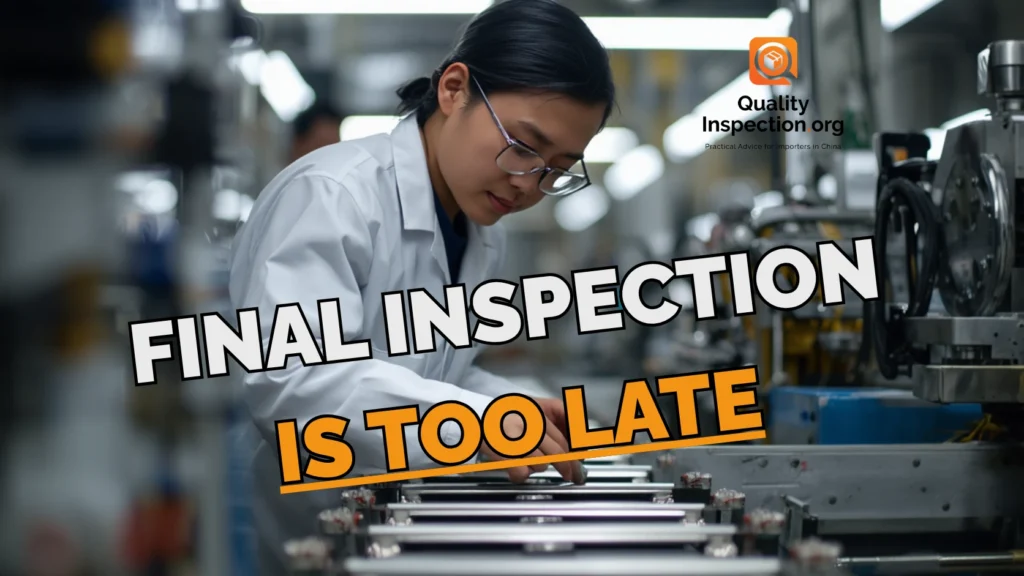
Finding defects during final inspection is better than shipping them to customers; it’s hard to argue with that.
But by that stage, the products have already been made.
If a large part of the batch has the same problem, inspection can identify the failure, but it cannot undo the time, materials, and production capacity already spent.
A stronger approach is to define how quality will be controlled before production begins.
Here we’ll explain three types of quality control plans:
1. A product quality control plan that defines inspection, testing, acceptance criteria, responsibilities, and what happens when products fail.
2. A process control plan that identifies critical production steps and explains how quality will be checked while the products are being made.
3. A QC plan for a new product that addresses additional risks involving approved samples, test fixtures, components, tooling, pilot runs, reliability, and compliance.
The discussion also explains why buyers need to define their own quality standards rather than assuming the supplier will do it for them.
Listen to the audio here or on Apple Podcasts · Spotify · Amazon Podcasts · Deezer · iHeartRADIO · TuneIn.
Table of Contents
Episode Sections:
- 00:00 Introduction to this rewind episode
- 01:56 What quality control plans are and why they are needed before production
- 04:06 Why there is more than one type of QC plan
- 04:43 Type 1: The product QC plan and contract-related quality terms
- 05:28 Defining testing, inspections, AQL limits, compliance, and responsibilities
- 06:41 What happens if serious issues are found after shipment?
- 07:11 Why even smaller buyers should document quality expectations
- 08:06 Type 2: The process control plan
- 09:04 Mapping production processes and critical steps
- 10:20 Turning the control plan into work instructions and checks
- 11:02 When process control plans become important
- 11:54 Why final inspection alone is often too late
- 12:27 Controlling quality through incoming components and sub-suppliers
- 13:50 How to check whether suppliers can follow process control plans
- 15:03 Type 3: The QC plan for a new product
- 16:27 Quality, reliability, and compliance requirements
- 17:35 Golden samples and approved prototypes
- 18:00 Testing stations, jigs, fixtures, and functional checks
- 19:07 Intended use, reliability expectations, and compliance needs
- 19:52 Component manufacturing, assembly, tooling, and work instructions
- 21:35 Pilot runs and pre-production approvals
- 22:35 Why new products force buyers and suppliers to think harder
- 22:59 Supplier optimism and the “we’ll fix it later” risk
- 24:16 Why quality standards need to be clear and useful
- 25:08 Why buyers often skip proper QC planning
- 26:42 Why defining requirements is the buyer’s job
- 27:40 Which QC plans apply to which buyers and products?
- 28:22 QC planning for all buyers vs larger or higher-risk buyers
- 29:26 Why process control is worth considering for new products
- 30:12 Why every buyer still needs at least a basic quality standard
- 31:12 What off-the-shelf and private-label buyers should focus on
- 33:02 2026 outro and key lesson recap
Further Reading
- Quality Control Plan: Defining Expectations Before Production
- How To Set Up A Process Control Plan [11 Steps]
- Golden Sample in Manufacturing
- What Is A PP Sample?
- How to set product specifications?
- You NEED to do product qualification BEFORE mass production!
- How Incoming Quality Control Inspections Fit into an Overall Quality System

