

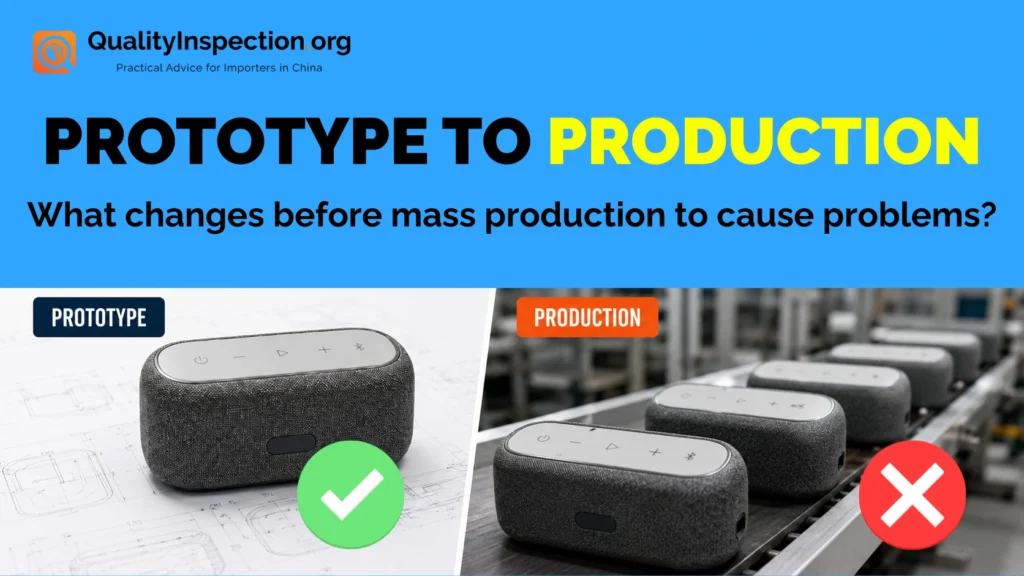
A prototype that works is encouraging. It proves that the concept is technically possible, gives the team something tangible to test, and often unlocks the next stage of investment or customer approval. But it does not prove that the product is ready for production.
This is where many hardware projects run into trouble. The prototype is approved, the team moves ahead, tooling starts, suppliers are lined up, and everyone assumes the production units will behave in the same way. Then the first batch arrives, and unexpected failures appear.
The reason is often simple: the prototype and the production unit are not really the same thing.
In this episode of China Manufacturing Decoded, Adrian and Paul Adams, head of new product development, discuss part one of this problem: what actually changes between prototype and production, and why those changes can lead to production failures if they are not controlled. Next week, we’ll continue the discussion by looking at common real-world failure patterns, including component swaps, firmware tidy-ups, factory transfers, and how a structured NPI process helps close the gap.
Listen to the audio here or on Apple Podcasts · Spotify · Amazon Podcasts · Deezer · iHeartRADIO · TuneIn.
Table of Contents
Episode Sections:
- 00:00 Introduction: why working prototypes can still fail
- 02:09 Prototypes and production units are not the same thing
- 03:46 The gap between prototype and production
- 04:23 Five things that change before production
- 04:36 1 – Components: prototype parts vs production parts
- 09:17 2 – Firmware: why prototype code is not production-ready
- 12:03 3 – Suppliers and factories: why process knowledge gets lost
- 16:50 4 – Tolerances and process variation
- 19:54 5 – Validation basis: What exactly was tested?
- 22:22 Key takeaway from part one
- 23:17 What to expect in part two

