

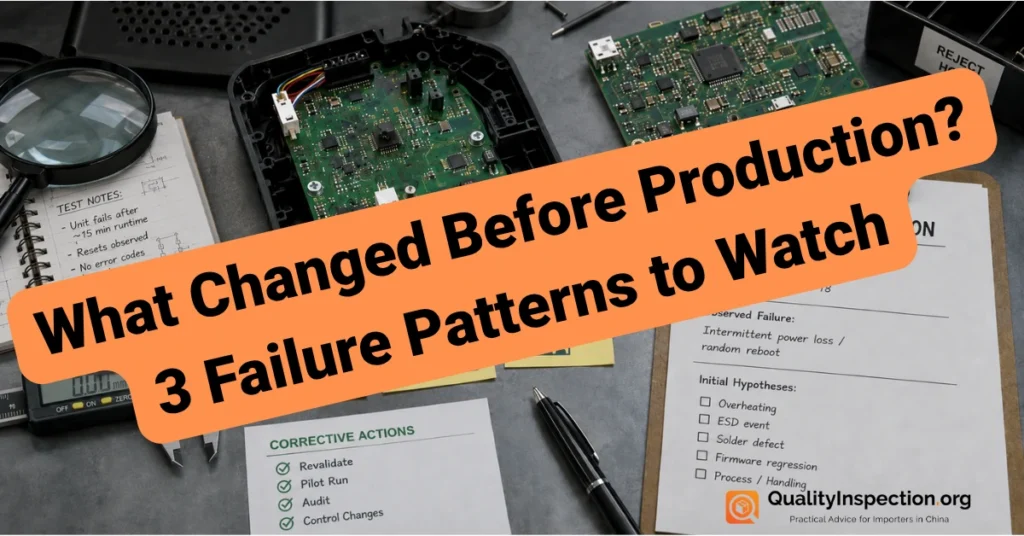
In the previous episode, we looked at what changes between prototype and production. In this second part, Adrian and Paul focus on three common failure patterns that often appear after prototype approval:
- A component is swapped for a cheaper or more available alternative.
- Firmware is cleaned up before production release.
- Production is transferred from a prototype shop to a mass production factory.
Each change may look reasonable on its own. The new component may appear equivalent on the datasheet. The firmware update may seem like routine tidying. The new factory may appear capable of making the same product. But each one can change the configuration that was originally validated.
That is why a working prototype is not the same thing as a production-ready product.
In this episode, you’ll learn why component changes, firmware changes, factory transfers, tolerance shifts, and process differences need to be controlled before production starts. We also cover practical safeguards, including configuration control, phase gates, production-representative builds, factory audits, pilot runs, and validation tracking.
Listen to the audio here or on Apple Podcasts · Spotify · Amazon Podcasts · Deezer · iHeartRADIO · TuneIn.
Table of Contents
Episode Sections:
- 00:00 – Introduction: why working prototypes still fail in production
- 01:32 – Failure pattern 1: component swaps and hidden validation risks
- 06:26 – Failure pattern 2: firmware tidy-up before production release
- 08:53 – Failure pattern 3: transferring from prototype shop to production factory
- 13:20 – How to bridge the prototype-to-production gap
- 13:48 – Why a structured NPI process matters
- 14:51 – Production-representative builds, EVT, DVT, tooling, and PVT
- 16:49 – Controlled ramp-up instead of jumping straight to mass production
- 17:32 – Configuration control: validation only applies to what was tested
- 20:29 – Practical decision framework for managers
- 22:03 – Setting a configuration baseline from DVT onward
- 23:05 – Using NPI phase gates and change assessment before moving forward
- 24:29 – Factory process audits: why an audit is not just a factory tour
- 27:09 – Pro tips: quality standards, NPI discipline, and validation tracking
- 30:39 – Factory transfers and why pilot runs are essential
- 33:05 – Final recap: what changed, what was validated, and what is now unknown
Further Reading
Get help with your project from Sofeast. These services cover the topics discussed today:

