

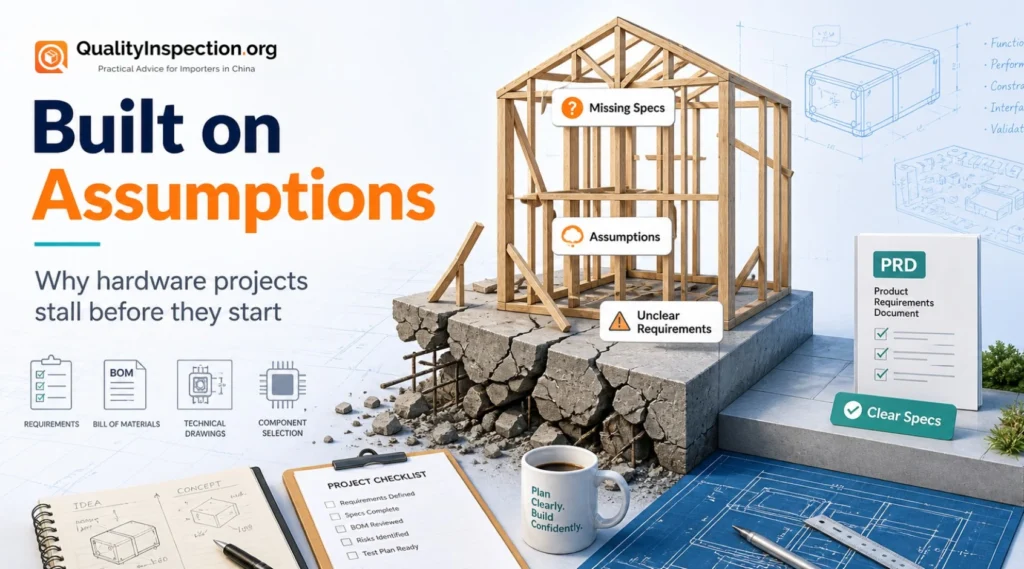
Many hardware product development projects do not fail because the idea is bad, the team is lazy, or the manufacturer is incapable. They fail because the project starts with too much missing information.
At first, this may not seem serious. The team has a concept. There may be sketches, a rough design, some target features, and a budget. Everyone wants to move quickly into design, prototyping, tooling, and production.
But when key details are missing, people start filling the gaps with assumptions.
One person assumes the product will use a certain material. Someone else assumes a component is available. Another assumes that the target market requires only one set of certifications. The engineer assumes a certain tolerance is acceptable. The buyer assumes the production cost will fit the business model.
Before long, the project is not built on confirmed information. It is built on a stack of assumptions.
And that is where many hardware projects stall.
In this episode, we look at why product development projects often fail to get moving, why a Product Requirements Document is so important, what information should be clarified before development starts, and how companies can avoid wasting weeks or months on work that later needs to be undone.
Listen to the audio here or on Apple Podcasts · Spotify · Amazon Podcasts · Deezer · iHeartRADIO · TuneIn.
Episode Sections:
- 00:03 — Intro & episode overview
- 01:01 — The “failure to launch” problem in hardware
- 02:01 — It’s not the team: real root causes
- 03:02 — Assumptions & missing information (core issue)
- 07:00 — Red flags: missing requirements & BOM
- 11:57 — What “ready to start” actually means
- 12:45 — NPI process & phase gates explained
- 14:22 — Specs as a living document (market changes
- 15:05 — Mechanical, electronics & feature requirements
- 17:34 — Volume assumptions & pricing impact
- 19:08 — The danger of rushing decisions
- 20:44 — Case study: prototyping failure under pressure
- 24:25 — Case study: component & supply chain risks
- 26:33 — Case study: regulatory & certification surprises
- 29:45 — The 10-point pre-start checklist
- 32:53 — Most common mistake
- 33:47 — Final takeaway
Further Reading
- Transitioning to Manufacturing from Product Development | 2 Options
- IP Protection in China when Developing Your New Product [Importer’s Guide]
- Bill of Materials (BoM) Explained
- Design to Cost (DTC) Explained
- Getting To Grips With Non-Recurring Engineering Costs (NRE) [Podcast]
- 11 Common Electronic Product Certification And Compliance Requirements
- Crowdfunding Failures: 4 Great Prototypes That Failed To Launch
- Learn more about how we handle DFM & Industrialization (NPI) for our manufacturing customers

